doingword.com

Archive for the ‘Uncategorized’ Category

Fender Vibrato/Tremolo

Sunday, September 11th, 2011

I had just read an article on Fender tremolos here. This article brought up the subject of the Fender three tube Vibrato/Tremolo. This is a tremolo effect that pans between two signals, one from a High pass and the other from a low pass. The sound while not truly tremolo and not really vibrato has a unique flavor that has qualities of both.

I’ve seen exactly two projects that make use of this. The first was a project from the now defunct Stompboxology Newsletter named Tremolo-Matic X. The other is the Vibrotrem by Bajaman ove at Freestompboxes.org. Basically the circuits do the same thing though they use different methods. The input signal is split and routed through a high pass and low pass network. A tremolo effect is applied to each of these signals with the cycles being 180 degrees out of phase. As the high pass increases in volume the low pass signal is decreasing and vice versa.

The Tremolo-Matic X uses a NE570 chip as two VCA. It uses a couple op-amps for a LFO and a few more as a buffer and the high and low pass networks. I built this and posted some notes here and here. The circuit had a great sound and was not difficult to build. The NE570 may be hard to get or cost prohibitive to some.

The Vibrotrem uses a LED/LDR to control the level of the high and low pass sections. Bajaman seems to have done thorough study of this type of tremolo and has optimized the filter section. I have not built this project, but have no doubt it would sound as good or better.

Caitlinbread makes a box, the Pareidolia that does a similar effect, without the controls for Bass and Treble. From their description it sounds like the Bass and treble fix at an optimal point where they share a midrange cross over. The clips on the site sound pretty good.

Posted in Uncategorized | No Comments »

True Bypass with an LED!

Saturday, September 10th, 2011

I bought this switch from Smallbear about ten years ago, probably around 2000. It cost $13! Before that time this was a high tech item that was only available in Fulltone products from what I understand. Legend has it that he had them designed and specially manufactured for his boxes. I guess wiring a true bypass box with an LED easily was worth it to him to invest the time and money to get these things made. Not sure how they ended up at Smallbear. Steve probably figured he could sell a few, I bought 1, and Mike Fuller had enough stock on hand to pass some on to Steve.

Now days you can get these everywhere and the prices seem to get as low as $3.50 each, though the price seems to have settled around $5 on average.

When I began doing this DIY stuff I made a few boxes with the Carling DPDT switch. To get an LED to work with one of these was a difficult proposition. A few people, mostly R.G. Keen, came up with a handful of ingenious circuits that would allow an LED to work with the DPDT. The most famous of which is the Millennium Bypass. At the time I felt this was a little beyond my skills so I never attempted to use one of these in a box. Mostly my boxes went without an LED.

Then I found the 3PDT switch and all of a sudden even I could have an LED. Provided of course I was willing to invest $13 into a box. Now days it’s not even a question of how to get the LED to light, this is the standard switch used by everyone professional and amateur. Heck this is the standard switch even when you don’t need an LED. I think Zvex still uses the Carling DPDT in the Fuzz Factory, I think the Fuzz Factory still doesn’t have an LED. Is the Fuzz Factory the new old school?

As long as we’re talking switches here’s a few pictures of switches. The first is the Fulltone 3PDT. Next is the Carling DPDT, I like to think of these as the vacuum cleaner switch. Third is the current ubiquitous 3PDT. Not sure where I got this one. Fourth and fifth is the X-Wing type DPDT. The sixth is a miniature 3PDT  switch from Mammoth Electronics. I had high hopes for this switch when I first saw them. After ordering a few I was less enthusiastic. The switches are not very tall often shorter than the knobs on a box. The holes in the solder leads are too small to fit most wire through. The body is a bit smaller than the standard blue 3PDT so they do save some space (I wrote more about this here). The last image shows a size comparison of all of the switches. Mammoth Electronics makes a 4PDT switch which I haven’t tried but might be good for something.

Posted in Uncategorized | No Comments »

Baritone Guitar

Thursday, September 1st, 2011

I had gotten this itch to get a baritone guitar. Not sure where it came from, maybe I was listening to to much Ennio Morricone? I must have bought it in the early 2000s. I found this on sale for $199 and thought it looked like a pretty good deal. It’s a Squier Sub-Sonic. The guitar is a baritone tuned to low B. The body is basswood and constructed as a neck through design. It has 24 frets with a rosewood fret board.The body is a dark blue almost black with a metallic or sparkle finish. The headstock is reversed with the smaller strat outline. The neck has a 27″ scale.I’d say the guitar was well made for the price I paid.

It plays pretty good. The strings are much larger than a regular guitar about half way to a bass guitar. The neck through body construction makes playing the upper frets very comfortable and natural. The frets are large. The guitar has a nice balance to it like other guitars in this body style. The body has the strat style cutaway.

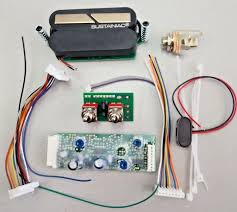
At some point I decided a Sustainiac would be a good thing here. Not sure why? I had the guitar routed by Gary Brawer for a 9V batter case and installed the sustainer. The sustainer is fun. I’m thinking about doing a couple posts about sustainers in the future.

The one problem I have had with the guitar has been the sound. Physically it’s just a six string with bigger strings. You’d think it would then sound like a typical six string tuned to a low B. This is not exactly the case. The G string is a solid non-wound type, but much heavier than normal. Rather than the bright sound of the typical solid strings in a regular gauge the string has a dull metallic twang. It sounds more like wire than the string on a musical instrument. From what I understand baritone strings are available with a wound G string. I think I will try a set like this the next time I change strings.

The pickups also sounded dull or muddy. I changed the bridge pick up for a Duncan Invader. This didn’t sound that great either. At this point I started thinking about what type of pick up would work well in this type of guitar. It seemed to me that the heavier strings produce more output from the magnetic coils in the pick ups. The guitar it self produces more bass. Seems this is a recipe for mud.

It seems this type of guitar would benefit from having a lower output pick up. Hopefully one that handled bass frequencies elegantly. The original pick ups measure 8.4K for the neck and 16.7K for bridge. Wow those are pretty hot. The Invader is listed as 16.8K. I think I need to go the other direction. Maybe a Jazz type pickup, something with a lower output.


Posted in Uncategorized | 1 Comment »

Mini Maker Faire in Oakland CA

Monday, August 22nd, 2011

Looks like there’s a mini Maker Faire in the east bay. The big Maker Faire in San Mateo this year, though it had a lot going on was so crowded that I couldn’t really enjoy it. This might be better at a smaller scale.
http://ebmakerfaire.wordpress.com/

Posted in Uncategorized | No Comments »

Pignose

Wednesday, February 23rd, 2011

The DIY swap meet was great. I saw this Pignose amp at one of the tables. Normally this wouldn’t really interest me. But, my wife had put this amp on her Amazon wish list. They wanted $40, I didn’t have the cash on hand. Luckily I sold a few things so I got the Pignose at the end of the day. Turns out one of the guys at the table lives in my neighborhood.

Anyway, here’s a few pictures. Gotta love the pigs nose shaped switch on the front.

My wife immediately found some batteries and tested it out. I try to encourage this behavior to reinforce the idea that it’s good to send me to the swap meet. Sort of like send Jack to the village with the cow. But, in this case the cow is cluttering the house and magic beans are something that makes everyone ooh and ahh.

I had been thinking about building a Ruby for some time, but had never gotten around to it. At $40 the Pignose even starts to look like a good deal compared to the Ruby. I’d have to order all the parts and spend some hours putting all together, and finding a good speaker could be problem. So all said the Pignose was a good deal.

Of course it does offend my DIY sensibilities. I have to admit that my first thoughts were to build a Ruby inside the Pignose! Luckily (for the Pignose) making it a gift to my wife has saved it from being taken apart.

Looks like it runs on 6 AA batteries, hmmm 9V… The idea of creating a small amp that runs on 9V is a good one. The Ruby gets great reviews on the internet. Not sure what type of speaker they use in the Pignose. But I’m sure it’s a guitar amp type. Th sound is pretty good, not great. It has an over driven quality, though not distorted. It also gets pretty loud. Not sure could annoy the neighbors, but I think I could get my child to say “stop, stop, stop playing that”.

One area where I could see improving the thing is to swap the DC jack on the back with a standard Boss style 9V type. The 1/8″ jack is so uncommon and inconvenient.

Posted in Uncategorized | No Comments »

DIY Electronics and Musicians Swap Meet

Wednesday, February 23rd, 2011

The DIY Electronics and Musicians swap meet was last Sunday. Good fun was had by all. I’m starting to realize I’m seeing the same people every year. Vendors and customers alike. Which is not a bad a thing. It was nice to hear the guy I traded the Fuzz Factory clone to was still enjoying it. I had traded for a small amp which I brought with me to test stuff with. It’s great to hear that everyone is happy. Then again it would great to see some new faces and open the Swap up to more people. There’s so much great stuff to be had, we need to attract the people to come and take a look at it all.

Joe Gore shared the table with me. He had a great looking line of stuff. The guy is a tireless perfectionist. The effects themselves sounded and looked great.

There are a few pictures of Joe below. The majority of stuff on the table was his. I didn’t have much this year. There are couple shots of what I brought at the other end of the table.

Not sure why, but no one likes Big Muffs? I’ve brought the same two big Muff’s with me for the last 4 or so years and haven’t sold one yet. They look good and sound good, well as good as any Big muff. The Ugly Face is popular. Of course these are unique I suppose. I sold a few PCBs. Anyone who bought feel free to contact me if you have any questions about putting it together. People asked about Germanium Fuzz, they seem to want Tone Benders more than Fuzz Faces. I had a few requests for Tone Benders last year also. Come to think of it, I was trying to trade Steve for his Tone Bender clone the year before last.

If you are the guy who lost the DIY sustainer at the swap, you left it on my table. I didn’t notice until after you had keft the building. I have it, contact me and I’ll see about getting it back to you.

Posted in Uncategorized | 3 Comments »

Sustainers

Monday, February 21st, 2011

I was at the DIY swap meet last weekend where I was shown a DIY “e-bow”. It consisted of an electric motor, 9V battery and switch. The shaft of the motor had what looked like a propeller made of electrical tape. The idea was to turn the motor on and hold the device so the spinning “propeller” of tape brushes the strings of your instrument thus creating a sustained sound. (If you left this at my table at the swap let me know and I’ll try and get it back to you)

Sounds pretty kooky at first, but this is not the first device to use this idea. But, before we go any further an explanation of sustainer and e-boy are in order.

The name sustainer, I’ll guess, comes from the sustain pedal on an organ or piano. The idea is to add sustain to the instrument. With stringed instruments you need something to drive the strings. Violins, violas etc, use a bow. I seem to recall reading about some type of hurdy gurdy that rested a spinning wheel on a string to act as a infinite bow. (Feel free to chime in with some details if you like.)  When it comes to guitars, electric guitars that is, the classic sustainer is amplifier feedback. The sound coming out of the speakers begins to drive the strings, which in turn creates more output from the pickups. I have often seen guitar players control feed back in various ways, one method is by pressing the headstock against the amplifier cabinet, which is a good way transfer the sound vibrations directly from the amp to the guitar.

Beyond feedback people have come up with very clever methods sustain. These fall into two methods: Physically vibrate the string or magnetically vibrate the strings. (Note that there have been several stompboxes called “sustainers”, but these are really more in the compressor limiter category).

Magnetic sustainers work on the concept of using an electro magnet to drive the strings. Really this is almost the same as driving a speaker cone. A signal from your amplifier is used to create a fluctuating magnetic field. This field pulls or pushes the speaker cone towards or away from a magnet in the speaker. The field itself mirrors the audio.

Magnetic sustainers use the same concept as a speaker. The difference that magnetic field is pulling at the strings on your guitar. Magnetic sustainers can be either hand held, like the E-Bow, or mounted in the Instrument like the Sustainiac.

The E-Bow is a small hand held device that contains small pick up similar to a guitar pickup and magnetic driver. The signal from the pickup drives the driver which makes the string vibrate. The more string vibrates the more signal is generated at the pick up which in turn creates a stronger signal at the driver. Sounds a lot like amplifier feed back in some ways.

The Sustainiac is system that replaces the neck pick up on an electric guitar. It works with the bridge pickup, amplifying the signal and powering the driver in the neck pickup. Sounds a lot like the E-Bow, except the Sustainiac mounts in the guitar. Moog music makes a guitar that has six magnetic sustainers, one to drive each string.

The next category of sustainers are mechanical sustainers. These would work by physically vibrating the strings. There was a device called the Gizomtron (love the name) that mounted on your guitar and used small wheels to drive the strings. Sustainaic also makes a sustainer, called the Model C, which attaches to the head stock and provides mechanical sustain by vibrating the headstock. Which brings us back to the motor and the 9V battery. Can you make a sustainer with an electric motor? The Gizmotron proves this is possible even if their device was never popular and had some problems. You really just need some way to get the strings vibrating. Here’s a video of Van Halen using an electric drill as a slide. The spinning action of the chuck is obviously creating some of the sound. Many times the simple solution is the best. There’s probably many off the shelf products that double as sustainers. Here’s the Lips from Anvil using a Dildo. Of course anything that effects the length of the string will effect the pitch. This has been done a few times by various others.

Not sure what else to say on the subject. It seems ripe for experimentation. If you don’t fancy expensive Moog guitar you can probably whip up your own sustainer from parts around the house!

Posted in Uncategorized | 2 Comments »

New Stompswitch

Friday, January 7th, 2011

You’re probably familiar with the classic blue 3PDT stomp switches that have been around for some years. These are ubiquitous in the stompbox realm. Everyone uses these, from the major manufacturers to the small builders and hobbyists. They work well and the cost is very reasonable. I paid $13 for an offical Fulltone 3PDT about ten years ago, but these days they can be had for $4 or $5 each. Which is very reasonable, though it does make the switch one of the most costly parts in any box.

Recently I ran into http://www.mammothelectronics.com/. Turns out they carry an alternative to the standard blue stomp switch, one that I had never seen before. I bought 5 of these to give them a try.

First impressions say they look well made. The travel on the button is less than the travel on the blue switches, about the half. The switch itself is smaller in all dimensions. It’s not a lot smaller, but the size difference could be significant in a tight project. The switch makes a satisfying click.

The nuts are a little smaller and look a little cheaper, compared to the nuts that come on the blue switches. The nuts look like the stamped nuts that come with some toggle switches. This is a little disappointing. I like having a tight fitting nut that you can get a good grip on and tighten up well with a wrench. These look like they would be hard to tighten up close to the surface of a box, and the nuts are so thin the wrench might slip off.

I’ll have to build something with one of these switches before I can say how well they work in real life.

Posted in Uncategorized | No Comments »

Distort-o-matic VI

Saturday, October 9th, 2010

Here’s a weird idea from the Stompbox Cookbook. Note, the PCB image is a positive.

Posted in Uncategorized | No Comments »

Taco Fry Fuzz

Saturday, September 25th, 2010

Everyone’s favorite 5 knob fuzz, with custom hand drawn Sharpie design.

Posted in Uncategorized | No Comments »